
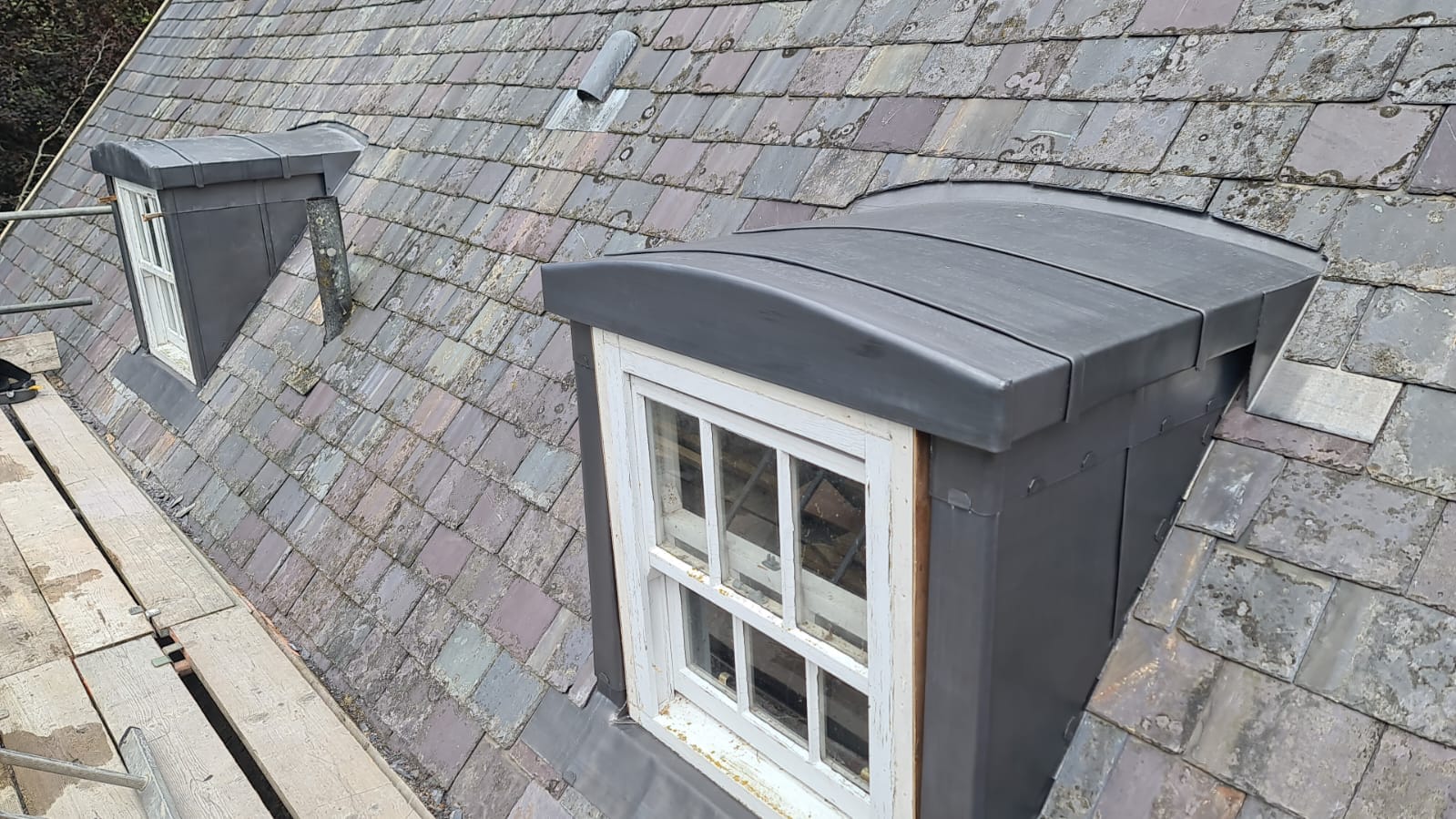
Leadwork and Lead Flashing in Jersey
Leadwork in Jersey covers lead flashing, dormers, flat roll top roofs, troughs, valleys and chimney detailing, all carried out in accordance with the Rolled Lead Sheet Association guidelines.
It is one of the most common causes of roof leaks when it fails, and one of the trickiest parts of any roof to get right, particularly around chimneys and abutments on older granite buildings.
What the job involves
Leadwork starts with identifying exactly where a roof needs flashing, typically at chimney stacks, valleys, abutments against walls or parapets, and around dormer windows and rooflights. We assess whether the existing lead can be reused, dressed back into place, or needs replacing entirely.
Installation involves cutting and dressing lead sheet to the correct code and profile for the location, forming step flashings, cover flashings and soakers as needed, and dressing the lead securely into raked joints in brick or granite so water cannot track behind it. Valleys and troughs are formed with the correct fall, width and expansion allowance for the pitch and the volume of water they carry.
Flat roll top roofs and lead-clad dormers are set out with the bay lengths, welts and rolls the guidelines specify, so the lead can move with temperature change instead of splitting. On repair jobs we often find the surrounding slate or tile has moved too, so we repair those areas at the same time to make the whole junction watertight.
Leadwork we carry out
- Step, cover and apron flashings to chimneys, abutments and parapets
- Lead-clad dormer cheeks, tops and window details
- Flat roll top lead roofs on bays, porches and small flat areas
- Lead troughs and box gutters between roof slopes and behind parapets
- Open and secret lead valleys on slate and tile roofs
- Chimney detailing, back gutters, saddles and soakers
- Lead slates and collars to soil pipes and flues
- Repairs and re-dressing of existing lead where it remains sound
Common problems we fix
- Chimney flashing pulled loose from raked joints in granite or brick
- Cracked or split lead from thermal movement, over-long bays or age
- Valley and trough leadwork perished or undersized for the water it carries in storms
- Wind-driven rain forcing water under lifted flashing edges during Atlantic gales
- Salt air corrosion accelerating wear on coastal chimney stacks
- Mastic and sealant repairs applied over failed lead by others
- Poorly detailed abutments where a flat roof or extension meets an older pitched roof
- Nail sickness in surrounding slates causing movement that displaces adjacent flashing
Materials and standards we use
We use code 4, 5 and 6 milled lead depending on the exposure, bay length and span of each detail. All leadwork is installed following Rolled Lead Sheet Association guidance on lap lengths, bay sizes, fixing and expansion allowance, which is the recognised reference for good practice in the UK and Channel Islands.
Where leadwork adjoins slate or tile coverings, that surrounding work is completed to a high standard, so the whole roof junction, not just the metal itself, is fixed and lapped correctly for Jersey's wind exposure.
How much does it cost in Jersey
Leadwork pricing is driven mainly by the number and complexity of details on a roof. A single chimney flashing is a relatively small job, while a roof with multiple valleys, troughs, abutments and lead dormers needs considerably more lead and labour time.
Access affects cost too, especially for chimney work where scaffolding is needed to work safely at height. The condition of the surrounding slate or masonry once we are up there can change the scope, and freight costs for lead sheet delivered to the island are factored into material pricing.
We always provide a free, written estimate so the scope and price are agreed before any lead is cut.
Frequently asked questions
- Why does my chimney flashing keep leaking?
- Most repeat leaks come from lead that's pulled loose from the raked joint, or flashing that's too short for the amount of rain being driven up against the stack in a storm. We refix and re-lap flashing properly rather than just sealing the visible gap with mastic.
- How long does lead flashing last?
- Correctly installed lead can last several decades. Lifespan depends on the code used, bay lengths and how well it was dressed and fixed, which is exactly why we follow Rolled Lead Sheet Association guidance rather than improvising details.
- Can you repair lead without replacing the whole valley?
- Often yes, if the lead itself is sound and the fault is a lifted edge or a split section. Where the lead has thinned or cracked extensively across its length, replacing the full valley or trough is usually more reliable than repeated patch repairs.
Related roofing services
See finished work across the island in our roofing gallery.
Get a free, written estimate
Call 01534 766100 or send the estimate form. We reply within a week. Monday to Friday, 08:00 to 17:00.
info@watertight.je · Lugano, Le Mont Cochon, St. Helier, JE2 3JA